Friday, February 12, 2010

Painting to Please Oneself


Watermelon with Grapes

© J.Licsko 2010

0il on canvas

20"x18"


I like to accept commissions occasionally because it offers the opportunity to step out of my self created comfort zone. There is a subtle tension, knowing that a painting could be rejected.


In the middle of October, collectors I had not yet met, had recently purchased a still life of mine from a favorite gallery, and now wanted another. All I was told was that they wanted a still life painting of a watermelon, and that it was intended to be hung in the same room as the first painting. I wanted to please them, and please my gallery too, but the only way I could proceed with confidence was to paint to please myself.


I tried two different watermelons from the farmer's market, both too late in the season for a rich red color inside, neither had seeds. Both were "Heirloom" and therefore small. Organic was not the way to go. I found large watermelons at the big chain supermarket, still not very good color, but the size looked right for a traditional still life. I finally accepted the fact that it would have no seeds, yet the large slice presented the gift of one seed.


The upcoming holiday commitments were adding to the delay in starting. Finding the right composition took much longer than I expected. My preference in a still life is for all the subject parts to be related, a continuity in the theme of the connecting parts. As an example, adding a flower may add the right color, and balance the composition perfectly, but it would seem to me a disconnected addition. I like a scene that appears to be close to a natural occurrence in real life. A watermelon is little more than a big ball until you cut a slice into it, but the slice and the larger part together are still awkward as a composition. It needed more, hence the grapes and the lime, small knife and cloth.

Aligning myself with all the energy of the new year, paint first touched the canvas on January 1, and on the third day, and every day after, I photographed the work hoping to get a more objective view of how I work. I finished the painting January 31, having recorded each day's work with a photo, and a record of the number of the day's hours of painting.

Estimated time working on the composition unknown. I totaled 177 hours of actual painting time in 31 days. All but two of those days were pure pleasure working with colors that make my heart happy. Day 28 and 29 were hard when I reached the inevitable doubts that I was never going to get the painting done in a reasonable time, and maybe the collector had a strong idea in mind, and this wasn't it. Days 30 and 31 were a relief because by then I could see that it was becoming what I had envisioned. The last two days were joyful, all about the highlights and deep shadows. In a recent conversation, artist William B. Eckert and I were in full agreement of how the best part of paintings happen in the last few days. I recommend always taking the last two days to slow down and enjoy the process. It is so nourishing to the creative spirit to take time to play .


The collectors were happy. I learned a lot. I am very pleased with both the experience and most importantly, the finished painting.

Friday, December 18, 2009

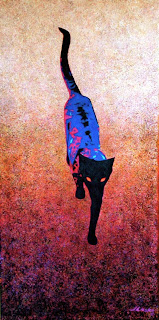
Creative People and Cats

"The Cat"
© JLicsko 07
24"x 48"
acrylic on canvas


It seems many work-at-home creative people have cats. Cats seem to be the perfect companion for a painter or writer with just the right energy and few demands. I have been blessed with the perfect feline companion who seems to enjoy my studio time as much as I do. I like to get my chores and obligations done before I paint, and she will often go to the studio and wait for me.


My cat, dear Sophie, likes to be where I like to be. I mean exactly. If I am standing while painting, I must remember not to step on her because she likes to sleep at my feet. Painting with a cat on ones lap is lovely in some ways, but it is not good for serious work. It is usually her choice to be on my lap, but, too much movement by me and she will remove herself indignantly. If I get up from my chair, she claims it immediately. I wonder sometimes if like dogs who clearly love to sit in the drivers seat when it becomes available, if cats don't feel that our chair is the seat of power and therefore rightfully theirs.


Sophie has some peculiarities, she was hired on originally as a mouser. She is an excellent hunter, and she did rid us of all of the household pests. As if she feels obliged to prove her worth, she now persists in bringing them in to the house and letting them go until she can catch them again at her leisure. Sophie is very quiet, hardly ever a meow. She only eats expensive cat food, graciously leaving human food alone. She never walks on the kitchen counter or table if we are at home. On all my canvases, one could probably find at least one cat hair unintentionally worked into the paint or varnish.


My son Adam, who also makes his living as an artist, had a sign in his studio which read "Dogs have masters, cats have staff". His cats spent many long hours keeping him company while he worked. MeMe, an intense personality in a small fur package, was an inspiration for many drawings featuring her Jekel/Hyde personality.


There is a facebook page, Artists and Cats created by Todd Pendu with 603 members http://www.facebook.com/group.php?gid=61949694304 , and a website too. http://www.pendu.org/exhibitions/artistsandcats/2008.htm


"Working with a group of artists is like herding cats" is an expression that I heard first this year when our arts organization was doing a fundraiser with thirty artists. I volunteered to be the link between the association and the artists. For the most part, it was a wonderful experience. Each artist as an individual was charming, cooperative, and delivered on time. As a collective, they were difficult to get all in the same place at the time. I have forgotten who said it first, but once we heard the phrase, it became the final word on dealing with a group of artists …. "Its like herding cats". If any of you are in that position of trying to organize a group of creative people, I recommend website essay written by Anne Miller, Director of The Creativity Partnership. http://www.tcp-uk.co.uk/docs/4022%20cat%20herder.pdf and David Parrish's Leading Creative People http://blog.davidparrish.com/tshirts_and_suits/2007/06/leading-creativ.html


Sophie has been the inspiration for several paintings. She is almost completely black. In the painting above, it is her sleek silhouette that inspired the painting above. Another painting is almost totally black with only her glowing eyes and blue highlight on her luxurious coat illuminated. Both paintings were for my own pleasure and not intended to sell, but they did. No complaints, because replacing them will be a labor of love.


Below is a few quotes about cats from a list of some of the world's most creative people. For more interesting facts and quotes about cats: http://www.greatdreams.com/cats/cats2.htm


Leonardo Da Vinci "The smallest feline is a masterpiece".

Adolf Hitler is known to have despised cats.

Garrison Keillor "Cats are intended to teach us that not everything in nature has a function".

Edgar Allen Poe "I wish I could write as mysterious as a cat".

Sir Isaac Newton, (theory of gravity) also invented the swinging cat door for the convenience of his many cats.

Albert Schweitzer "There are two means of refuge from the miseries of life: music and cats".

Aldous Huxley "If you want to be a psychological novelist and write about human beings, the best thing you can do is keep a pair of cats".

Friday, November 6, 2009

PAINTING GLASS


"Late Afternoon Red"
© J Licsko 09
36"x 36" oil on canvas


I live in the Paso Robles wine country, up on a hill, surrounded by grapes, amid hundreds of wineries, and a multitude of tasting rooms. At almost every social gathering, local vintners offer samples. In the five years I have lived here, I have witnessed first hand the subtleties of the seasons in the vineyards. From bud break (that's the first sign of leaves in the spring) to the rich red and gold colors of harvest, I have watched enchanted, but never been inspired to paint the scenes.

Recently, I was asked by one of my art dealers if I could paint for a show that featured wine culture as the subject. He had a specific nationally known artist's style in mind, when he asked. It is my observation that one always learns from stepping outside my comfort zone, so I took the challenge. I was surprised at how much I enjoyed painting all the sparkles of light on the glass, the sumptuous curves of bottles and glass, and the deep rich reds in the wine. I felt restrained by the requested style of painting, but overall the experience was very stimulating.

What I like best about my new series of wine paintings is the curves. Those who have gone to art school may have done endless exercises in creating the perfect curves, but it is relatively new to me. I have been learning as I go. Each glass offers the chance to study how light changes as the curve does. Curves change abruptly if two glasses are layered one in front of the other, or when a reflection breaks the line. A line that appears to be too long is very often too thin.
The most important lesson for me is that there is an noticeable emotional satisfaction when the line becomes correct. Either intuition, gut feeling, or visual recognition ( I'm not sure which) confirms in the most satisfying way that it is right.

"Late Afternoon Red" is my first painting of this series.